


01 - CAPIM-RABO-DE-BURRO Schizachyrium condensatum (Kunth) Nees (POACEAE)
01 - Capim rabo de burro - Schizachyrium condensatum (Kunth) Nees (POACEAE)
Perennial plant, 0.35 - 1.1 m in height, stems erect, with no branches in the upper nodes. Leaves 3-25 × 0.2 - 0.8 cm, with or without hair on both sides. Inflorescence up to 45 cm high, with many flowering branches, with spikelets of abundant hair, giving the appearance of plumes, or as the popular name suggests resembling a donkey tail.
This is not a plant that we associate with the city. Visually transports us to the field, where we are supposed to have a healthier life. Or at least greater contact with what we called nature. Perhaps a good start for thinking about nature is to remember to respect our biology, which in urban life can be an important differential. This plant can be a good reminder of that.
Distribution: Native throughout tropical and subtropical America, occurring in groups in savannahs and dry fields with sandy or stony soils, and in altered locations.
Situation in São Paulo: Present in some vacant lots and on the edges of highways, forming dense massifs where it becomes the predominant species. It was what I saw on a large abandoned lot on the Anhanguera Highway, which functioned as a truck parking lot and had part of the paved land. The grasses grew over the asphalt, demonstrating that if the city were abandoned it would be covered by vegetation in a few years.
How to plant: It is easily multiplied by seeds, which are produced almost all year round as well as by clump division. When transplanting it, we recommend that you remove the entire root ball and dig a double hole, fluffing the soil. Keep the largest portion of the leaves around and, if necessary, add others to protect the plant's collar, maintaining the necessary humidity for it to re-establish itself.
Uses: Used in restoration projects, mainly in footpaths and humid fields, due to its capacity for good coverage and soil stabilization, as well as for ornamentation of gardens, although most landscapers prefer to use exotic texas grass.
LONGHI-WAGNER, HM ET AL. FANEROGAMIC FLORA OF THE STATE OF SÃO PAULO. VOL. 1. POEACEAE. FAPESP / HUCITEC, SÃO PAULO, 2001.

Coletando sementes de capim-rabo-de-burro. Não tem segredo, terrinha, sol, e uma boa irrigação. Você terá centenas de mudas!

Primeiros capins-rabo-de-burro plantados por pessoas em São Paulo! Culturalmente, este capim é visto como uma praga e sempre foi eliminado por jardineiros, paisagistas, hortelãos, pecuaristas etc. O Cerrado Infinito inverteu essa lógica colonialista, inaugurando um pensamento eco-cultural campestre na contramão da história do urbanismo de São Paulo.

Icônico, esta espécie foi uma das primeiras que plantamos em 2015, logo no começo do processo. Depois de algumas semanas, com as plantas já adaptadas, alguém botou fogo, um recado de que não seria fácil mudar a cultura sobre eles.

Não deixa de ser irônico conseguir convencer alguém a pegar na enxada para plantá-los. Há coisas que entendemos melhor usando as mãos: a atividade manual é uma extensão mental, importante de várias formas. Infelizmente, muita gente associa o uso da ferramenta a um ato de servidão.

No início, os jardineiros da prefeitura eram uma ameaça. Já existia um histórico de conflitos com outras iniciativas de plantio na praça. Eles cortavam tudo entre 5 cm e a copa das árvores, mas logo entenderam do que o Cerrado Infinito se tratava. Muitos tinham vindo de áreas rurais e conheciam as plantas. Provavelmente, a saudade da paisagem de origem de alguns deles tenha ajudado a criar uma simpatia para preservar as plantas do Cerrado Infinito.

O capim-rabo-de-burro iluminado à noite na Casa das Caldeiras em 2022. Ao longo dos anos, ele começou a ser adotado por alguns paisagistas em composições florísticas que buscam evocar ambientes naturais. Infelizmente, a esmagadora maioria ainda prefere usar o exótico capim-do-texas, que já se espalhou pela cidade e compete com os capins nativos.
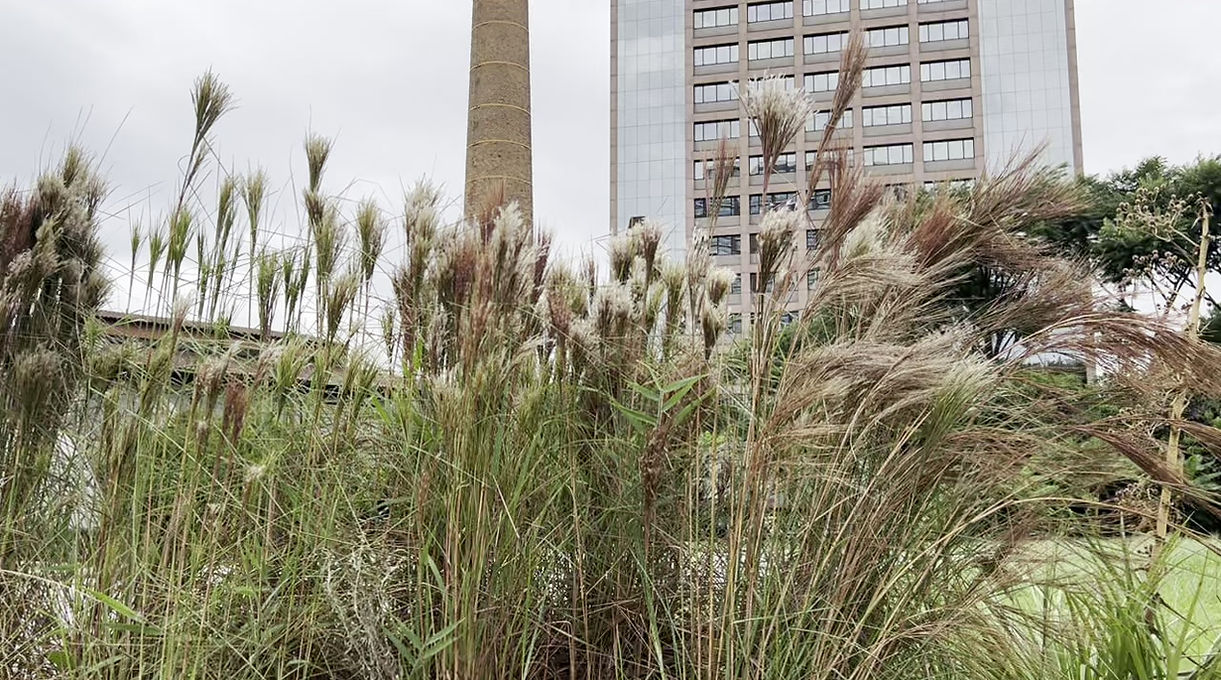
A fábrica submersa nos capins-rabo-de-burro? A vontade era essa, mas os poderes da cidade não deixaram o cerrado continuar, depois de um ano ele foi destruído.